
Death Valley holds the record for the hottest temperature ever measured on Earth — 134°F, recorded at Furnace Creek in July 1913. That's the number that sticks in people's heads, and it keeps a lot of RV travelers from considering this park at all.
Their loss. Between October and April, Death Valley transforms into one of the most rewarding RV destinations in the western United States — 3.4 million acres of salt flats, slot canyons, sand dunes, and mountain passes, with campgrounds that sit below sea level and skies dark enough to see the Milky Way without binoculars.
The catch: this isn't a park you can wing. Only 32 full-hookup RV sites exist in the entire Death Valley area, campground size limits vary from 25 to 100 feet, and some of the most popular scenic roads are completely off-limits to RVs. Here's everything you need to plan an RV trip that works.
TL;DR
- Best time to visit: October through April — summer exceeds 120°F and most campgrounds close
- Full hookup sites: Only 18 at Furnace Creek (NPS) and 14 at Stovepipe Wells RV Park (private) — book Furnace Creek 6 months ahead
- RV size limits: Vary by campground — Furnace Creek allows up to 100 feet, but Wildrose and Mahogany Flat cap at 25 feet
- Road restrictions: Titus Canyon is completely off-limits to RVs; Artist Drive is tight for anything over 25 feet
- Dispersed camping: Allowed on designated backcountry roads, but most require high clearance and aren't practical for standard RVs
- Nearest rental cities: Las Vegas (2 hours) and Los Angeles (4.5 hours)
When is the best time to RV camp at Death Valley?
The short answer: October through April. The longer answer depends on what you're after.
Death Valley's camping season tracks the temperature cycle at Furnace Creek, which sits 190 feet below sea level — the lowest point in North America. NPS weather data for Death Valley shows the temperature swing across seasons is dramatic:
- October — highs around 93°F, lows around 64°F. Campgrounds reopen; warm days and comfortable nights.
- November — highs around 77°F, lows around 51°F. The sweet spot: ideal hiking and camping temperatures.
- December — highs around 66°F, lows around 41°F. Cool and clear; bring a heater for overnight.
- January — highs around 67°F, lows around 43°F. The coldest month at lower elevations, and it can freeze at Wildrose (4,100 ft).
- February — highs around 74°F, lows around 49°F. A warming trend, with wildflower scouts arriving in wet years.
- March — highs around 83°F, lows around 57°F. Comfortable camping and a popular season as spring break crowds build.
- April — highs around 91°F, lows around 65°F. The last comfortable month before summer closures approach.
- May through September — highs of 101–117°F, lows of 75–91°F. Dangerous heat, most campgrounds closed, and not recommended for RVs.
In our experience, the RV renters who have the best Death Valley trips come in November or February. November catches the post-summer reopening before holiday crowds arrive, and February offers warming days with a chance at wildflower blooms if winter rains were generous.
Elevation matters here. Temperature drops 3–5°F for every 1,000 feet you gain. Furnace Creek sits at -190 feet; Wildrose Campground sits at 4,100 feet. On the same January night, Furnace Creek might hit 43°F while Wildrose drops below freezing.
Which Death Valley campgrounds are best for RVs?
Death Valley has nine developed campgrounds, but only six realistically work for RV camping. Here's the breakdown with the details that actually matter for RV planning — size limits, hookup availability, and seasonal access.
Furnace Creek — the one with hookups
Furnace Creek is the anchor campground for most RV trips to Death Valley, and for one reason: it's the only NPS campground in the park with full hookups.
- Sites: 136 total, 18 with full hookups (30/50 amp electric, water, sewer)
- Elevation: -190 feet (below sea level)
- Season: Year-round
- Reservations: Available October 15–April 15 via Recreation.gov; first-come, first-served rest of year
- RV length: Up to 100 feet (site-dependent)
- Amenities: Flush toilets, dump station, water, fire rings
- Fee: Check Recreation.gov for current rates
- Stay limit: 14 days per calendar year
Those 18 hookup sites book out fast. Recreation.gov opens reservations six months in advance, and peak-season weekends in November and March often fill within hours. If hookups are non-negotiable, set a calendar reminder for the six-month mark.
Note: Electric vehicle charging is not supported at Furnace Creek Campground.
Sunset — the big-rig option
- Sites: ~270
- Elevation: -190 feet
- Season: October–April
- Reservations: First-come, first-served
- RV length: No maximum
- Amenities: Flush toilets, dump station, water
- Generator hours: 7 a.m.–7 p.m.
Sunset is the overflow campground for Furnace Creek — sprawling, flat, and designed for RVs. No hookups, but no size restrictions either. It's where the big Class A motorhomes end up, and the dump station makes multi-day stays practical even without connections.
Texas Springs — the quiet one
- Sites: ~92
- Elevation: Sea level
- Season: October–April
- Reservations: First-come, first-served
- RV length: 35 feet maximum
- Amenities: Flush toilets, water, fire rings
- Generators: Not allowed
Texas Springs sits slightly above the valley floor with better views than Sunset and more spacing between sites. The tradeoff: generators are banned entirely, so you'll need solar or a fully charged battery bank. The 35-foot limit rules out most Class A motorhomes.
Stovepipe Wells (NPS) — sand dunes access
- Sites: ~190
- Elevation: Sea level
- Season: October–April
- Reservations: First-come, first-served
- RV length: No maximum
- Amenities: Flush toilets, dump station, water
- Generator hours: 7 a.m.–7 p.m.
The main draw here is proximity to Mesquite Flat Sand Dunes — you can walk to them from the campground. Stovepipe Wells Village (the adjacent resort) has a general store, gas station, and restaurant, which is useful when your RV fridge runs low.
Mesquite Spring — the remote choice
- Sites: ~30
- Elevation: 1,800 feet
- Season: Year-round
- Reservations: First-come, first-served
- RV length: 35 feet maximum
- Amenities: Flush toilets, dump station, water, fire rings
Mesquite Spring sits in the park's northern section, far from the Furnace Creek hub. That remoteness is the point — fewer crowds, darker skies, and a cooler elevation. The 35-foot limit and distance from services make it better suited for self-contained RVs.
Wildrose — the high-elevation option
- Sites: ~23
- Elevation: 4,100 feet
- Season: Year-round
- Reservations: First-come, first-served
- RV length: 25 feet maximum
- Amenities: Pit toilets, no water, no dump station
Wildrose is the only campground where freezing temperatures are common from November through February. The 25-foot limit and lack of water make it a campervan or small trailer destination, not a full-size RV stop. But it's free, uncrowded, and 15–20°F cooler than the valley floor in any season.
Where can you get full hookups near Death Valley?
This is the question that defines most Death Valley RV trip planning. With only 18 NPS hookup sites, the math doesn't work for most travelers — especially if you're arriving without a reservation.
Inside the park
Furnace Creek Campground (NPS): 18 full-hookup sites. The only NPS option. Book six months ahead via Recreation.gov for October–April stays.
Stovepipe Wells RV Park (private): 14 full-hookup RV sites operated by the Stovepipe Wells Village resort. These are separate from the NPS campground across the road. Contact the resort directly for reservations and current rates.
Fiddlers' Campground (private): Operated by The Oasis at Death Valley (adjacent to Furnace Creek). No hookups — but resort amenities include Wi-Fi, a spring-fed pool, showers, and access to The Ranch restaurants. Back-in sites only.
Gateway towns
Beatty, Nevada (7 miles from park boundary): Death Valley Inn & RV Park offers full-hookup sites at lower prices than in-park options. Also a reliable fuel stop.
Shoshone, California (25 miles from park boundary): Shoshone RV Park has full-hookup sites and serves as a southern gateway.
Panamint Springs (inside the park, western side): Panamint Springs Resort offers RV sites with hookups on the western approach via CA-190. It's privately owned and remote — stock up on fuel and groceries before arriving.
The pattern we see in our booking data: Death Valley rentals spike in November and February — shoulder months when the crowds at Furnace Creek thin out but the weather is still comfortable for hiking and stargazing. If you're flexible on dates, midweek arrivals in these months give you the best shot at a campsite without a reservation.
Can you drive an RV through Death Valley?
You can — but not everywhere. Death Valley's main roads handle RVs without issue. Several scenic roads do not.
RV-friendly roads
- CA-190 (main east-west route): The primary park road connecting Stovepipe Wells, Furnace Creek, and the eastern entrance. No RV restrictions, two lanes, well-maintained.
- Badwater Road: The paved road south from Furnace Creek to Badwater Basin (-282 feet, lowest point in North America). Fully RV-accessible.
- US-95 (from Las Vegas): The standard approach from Vegas via Beatty. Straightforward highway driving.
Roads with restrictions or warnings
- Titus Canyon Road: Completely off-limits to RVs. One-way, unpaved, and narrow with tight switchbacks. This is the road that surprises people — it's one of Death Valley's most popular drives, and you simply can't do it in an RV.
- Artist Drive: A one-way loop off Badwater Road. Paved but narrow with sharp curves. Not recommended for anything over 25 feet. Technically no posted RV ban, but you'll regret bringing a Class A through here.
- Scotty's Castle Road: Closed indefinitely due to flood damage. Check NPS updates before planning a route that includes it.
- Emigrant Canyon Road (to Wildrose/Mahogany Flat): Paved to Wildrose, then unpaved. RVs over 25 feet shouldn't attempt the upper section.
Fuel planning
We hear from RV owners that the biggest surprise at Death Valley isn't the heat — it's the fuel situation. Only three stations operate inside the park: Furnace Creek, Stovepipe Wells, and Panamint Springs. All three charge a premium. Fill your tank in Beatty, Pahrump, or Ridgecrest before entering, and don't rely on in-park fuel unless you've confirmed availability.
Cell service: Extremely limited throughout the park. Furnace Creek has spotty coverage. Everywhere else, assume you're off-grid. Download maps, save campground details offline, and consider a satellite communicator for emergencies.
Is dispersed camping allowed for RVs in Death Valley?
Yes, with significant caveats. Death Valley allows backcountry roadside camping on designated backcountry roads — but most of those roads require high-clearance 4WD vehicles, which rules out the vast majority of RVs.
Park rules for backcountry camping
- Camp only on designated backcountry roads (check the NPS backcountry access map)
- Must be at least 1 mile from any developed area or paved road
- Must be at least 100 yards from any water source
- No campfires in most backcountry areas
- Pack out all trash — no services, no facilities
The RV reality
Most backcountry roads in Death Valley are unpaved, rocky, and narrow. Echo Canyon Road, Cottonwood Canyon Road, and Racetrack Valley Road are popular dispersed camping routes, but they're designed for Jeeps and overlanders — not for a 30-foot travel trailer or Class C motorhome.
If you're in a high-clearance campervan or small 4WD RV, some backcountry roads may be accessible. Check current road conditions with the ranger station at Furnace Creek before heading out.
BLM land alternatives
For standard RVs looking for dry camping near the park, Bureau of Land Management land outside the park boundaries offers more practical dispersed camping. The BLM areas around Beatty, Shoshone, and along the western park boundary have fewer restrictions and more RV-accessible terrain than the park's backcountry roads.
Where should you rent an RV for a Death Valley trip?
Two cities make sense as starting points — and your choice depends on which direction you're coming from.
Las Vegas, Nevada (2 hours)
The closest major rental city. Take US-95 north to Beatty, then enter through the park's eastern boundary. The drive is straightforward desert highway — flat, wide, and RV-friendly. Stock up on fuel and groceries in Beatty (the last full-service town before the park).
Browse Las Vegas RV rentals for options.
Los Angeles, California (4.5 hours)
The most popular pickup city for California-based renters. Two main routes: CA-14 through Ridgecrest to the park's western entrance (more scenic, slightly longer), or I-15 through Barstow to the park's southeastern entrance. Either way, fill up before the final leg — there's limited fuel once you leave the highway towns.
Browse Los Angeles RV rentals for options.
What to look for in a Death Valley RV
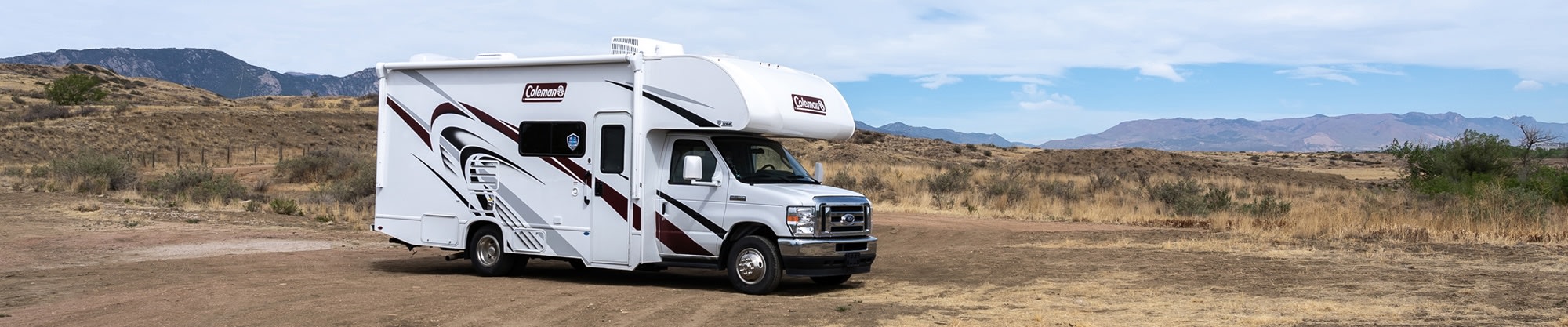
Renters who've done Death Valley in a Class A tell us they wish they'd sized down — a Class C or campervan handles the park's narrow scenic drives and tight campground loops much better than a 35-footer.
For a Death Valley trip specifically, prioritize:
- Robust air conditioning: Even in October, daytime temperatures hit the 90s. A single-unit AC that struggles in 85°F weather won't cut it here.
- Larger fresh water tank: Hookups are scarce. A 40+ gallon fresh water tank lets you camp at no-hookup sites like Sunset or Texas Springs without running dry.
- Good ground clearance: If you want to explore any unpaved park roads, a van-style RV with higher clearance gives you more access than a low-riding motorhome.
- Generator or solar: Texas Springs bans generators entirely. A solar setup lets you keep lights and the fridge running without noise restrictions. Check our RV hacks and tips for more desert-specific advice.
About this guide
This guide draws on campground data, road restriction information, and seasonal guidelines from the National Park Service's Death Valley camping page and developed campgrounds page. Temperature averages are from park-area weather station records. Reservation details reference Recreation.gov's Furnace Creek Campground listing. RV-specific insights — sizing advice, fuel planning, hookup strategy, and seasonal timing — reflect patterns from Outdoorsy's rental and booking data across thousands of Death Valley–bound trips. All information was verified against current NPS sources as of August 2026.